Assess
Symptom score, flow studies, bladder ultrasound, urine culture and flexible cystoscopy help confirm whether GreenLight is a reasonable option for your prostate size and urinary symptoms.
Photoselective vaporisation of the prostate
GreenLight laser vaporisation uses a 532 nm KTP laser, delivered through a side-firing fibre inside a cystoscope, to vaporise obstructing prostate tissue. The 532 nm wavelength is preferentially absorbed by haemoglobin, which gives excellent bleeding control during the procedure.1, 2
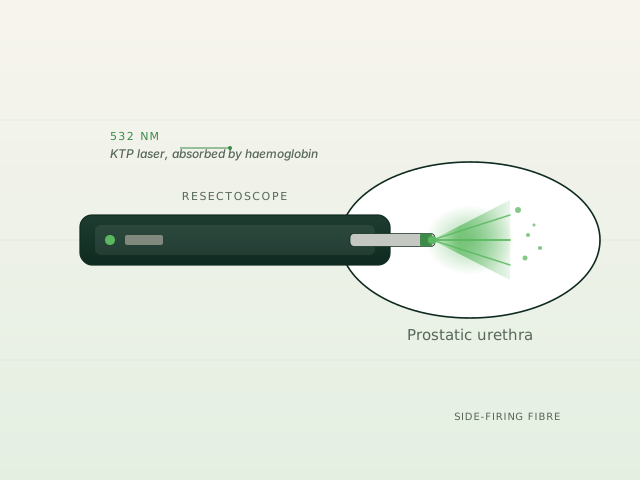
The 532 nm KTP (potassium titanyl phosphate) laser beam passes through water and is strongly absorbed by haemoglobin in the prostate tissue. That selective absorption is what makes the laser vaporise vascular tissue efficiently while sealing small vessels as it goes.1
Because the 532 nm wavelength is preferentially absorbed by haemoglobin, the laser tends to leave a well-sealed surface. Published series report good safety even in men on oral anticoagulants.2
In Australia, GreenLight is typically performed as a day-surgery or overnight procedure. The catheter is usually removed 24 to 48 hours after surgery.
The vaporisation rate is efficient for prostates in the small-to-medium range. Very large glands are often better suited to enucleation techniques such as HoLEP.4
Short introductory video recorded for patients. Video will play in place once you click.
Symptom score, flow studies, bladder ultrasound, urine culture and flexible cystoscopy help confirm whether GreenLight is a reasonable option for your prostate size and urinary symptoms.
Under general or spinal anaesthetic, a cystoscope is passed along the urethra and the side-firing laser vaporises obstructing prostate tissue at 532 nm.
A small catheter is typically left in for about 24 to 48 hours after surgery. Most men go home the same day or the following morning.
A follow-up with flow study and bladder scan is arranged at about six weeks. Sexual activity and heavy lifting are deferred for a short recovery window.
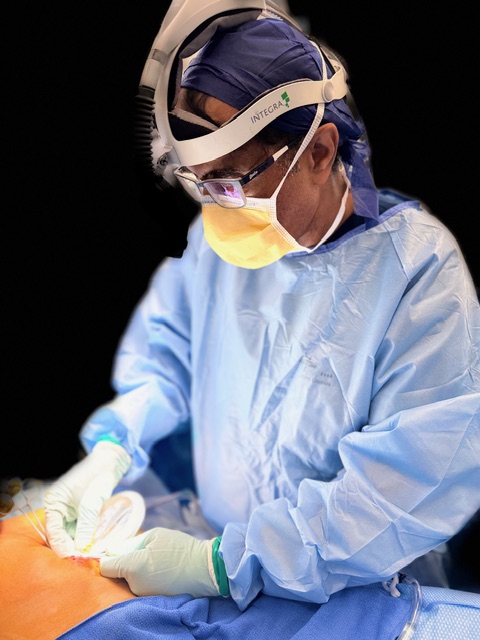
Dr Kooner is a senior Sydney urologist who offers the full range of transurethral treatments for benign prostatic hyperplasia, including GreenLight laser vaporisation and HoLEP. He selects the right operation for each patient based on prostate size, bladder function, blood thinner status and personal priorities.
Clinical care, referrals and the wider range of urological services are provided through Urology NSW. A full curriculum vitae, publications list and media record are on rajikooner.com.au.
Downloadable patient information from the British Association of Urological Surgeons (BAUS). Open in a new window.
Suite 1303, Level 13
406 Victoria Street
Darlinghurst NSW 2010
Suites 905 and 902
438 Victoria Street
Darlinghurst NSW 2010
Suite 1.12, Level 1
3-9 Gillies Street
Wollstonecraft NSW 2065
Suite 9
70 Bowral Street
Bowral NSW 2576
75 Crown Street
Woolloomooloo NSW 2011
Ask for a second opinion on your symptom score, flow studies and prostate size before committing to a treatment plan.